urban development concept
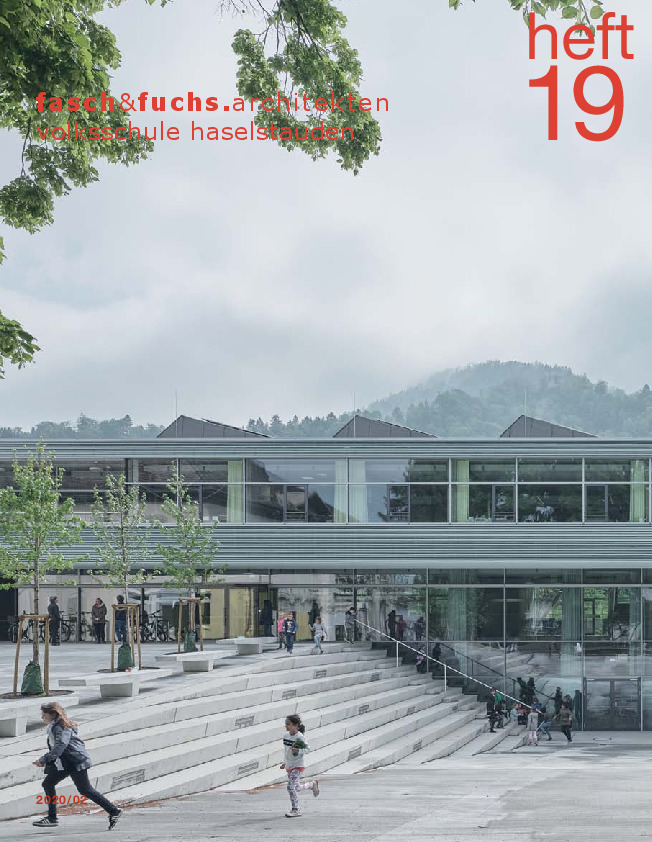
the site for the new haselstauden elementary school is characterized by its favorable location in the haselstauden district center, right next to the church. the demolition of the 1960s building and the removal of the 19th-century old building will enable the creation of new, spacious school grounds with different seating areas and new access routes for pedestrians and cyclists. the new schoolyard will be connected to the haselstauden village square, yet will still be designed to be distinct. the new elementary school will be embedded in the terrain in such a way that essentially only one upper floor will be visible. this means that the structure of small, detached houses to the east and south of the school will not be impaired by a tall building. a large, sunken forecourt, the new school arena, allows for the creation of a fully-fledged level -1. the terrain design gives both level 0 and level -1 direct access to the schoolyard.
the schoolyard is connected to the village square to form a large unit. the topographical design defines the schoolyard as an independent space. various craft and music activities can take place in this space, which is protected from street noise by the lowering. the sloping level encourages cycling and skating, while observers can sit in the shade under the trees. for summer festivals, the two-story auditorium opens up to the sloping school arena.
indoor campus
the entrance area, auditorium, dining area, administration, after-school care, and creative rooms form a spacious, connected learning landscape over two levels.
this indoor campus offers space for events of all kinds and is a meeting place for all students. it invites them to sit and observe, is a place for relaxation, play, and learning, and allows for easy orientation within the building. a large seating arena connects the entrance level with the level below and continues into the outdoor space, where an outdoor arena for public school events is being created.
the site for the new haselstauden elementary school is characterized by its favorable location in the haselstauden district center, right next to the church. the demolition of the 1960s building and the removal of the 19th-century old building will enable the creation of new, spacious school grounds with different seating areas and new access routes for pedestrians and cyclists. the new schoolyard will be connected to the haselstauden village square, yet will still be designed to be distinct. the new elementary school will be embedded in the terrain in such a way that essentially only one upper floor will be visible. this means that the structure of small, detached houses to the east and south of the school will not be impaired by a tall building. a large, sunken forecourt, the new school arena, allows for the creation of a fully-fledged level -1. the terrain design gives both level 0 and level -1 direct access to the schoolyard.
the schoolyard is connected to the village square to form a large unit. the topographical design defines the schoolyard as an independent space. various craft and music activities can take place in this space, which is protected from street noise by the lowering. the sloping level encourages cycling and skating, while observers can sit in the shade under the trees. for summer festivals, the two-story auditorium opens up to the sloping school arena.
indoor campus
the entrance area, auditorium, dining area, administration, after-school care, and creative rooms form a spacious, connected learning landscape over two levels.
this indoor campus offers space for events of all kinds and is a meeting place for all students. it invites them to sit and observe, is a place for relaxation, play, and learning, and allows for easy orientation within the building. a large seating arena connects the entrance level with the level below and continues into the outdoor space, where an outdoor arena for public school events is being created.
the spatial concept of the indoor and outdoor campus is designed to support the spirit of the school:
openness, clarity, orientation, networking, generosity, light-flooded friendliness, and flowing transitions between inside and outside. in the warm season, the auditorium, dining area, and creative rooms can be opened up to the covered outdoor areas, allowing for outdoor dining or relaxation and work in outdoor studios.
core learning area
four classrooms each connect to the open marketplace, the teachers' room, the cloakroom, and the sanitary facilities to form a learning area. large roof sheds on the upper floor extend the height of the learning landscapes and also provide optimal, glare-free lighting from the north. walk-on glass floors bring daylight into the lower floors as well. each learning area has its own access, thus creating identification and responsibility. glass elements allow teachers to oversee the learning zones from the adjacent rooms and promote cross-year collaboration. the marketplaces have direct access to a rain-protected outdoor area directly in front of them, and continuous balconies extend the classrooms.in each classroom, a small niche offers a place of retreat for small groups. the support and integration area is centrally located between the learning areas.
open spaces
it is important for the health of the students to switch between indoor and outdoor spaces as often as possible. outdoor lessons, even protected from the rain, can take place in the immediate vicinity of the classrooms and learning landscapes. part of the spatial concept is the extension of the learning areas to include outdoor areas directly in front of them, such as outdoor campuses, open-air classrooms, and balconies. the different spatial situations offer a wide range of uses for different groups and individuals. the areas are clearly laid out and open, usable by everyone and for many purposes.
- location:
- haselstauderstraße 20, 6850 dornbirn, austria
- client:
- stadt dornbirn
- architecture:
- fasch&fuchs.architekt:innen
- team architecture:
- marija babic, robert breinesberger, christian daschek, christian federmair, sunhild fritz, stefanie schwertassek
- project management:
- constanze menke
- specialist planner - cost management:
- arch. di günter bösch
- structural engineering:
- werkraum ingenieure zt gmbh
- building physics:
- dipl.-ing. bernhard weithas gmbh ingenieurbüro für bauphysik
- building services engineering:
- energieberatung & haustechnik müllner gmbh
- electrical systems:
- ingenieurbüro hiebeler-mathis og
- fire safety:
- huber wolfgang ingenieurbüro
- geotechnical survey:
- 3p geotechnik zt gmbh
- infrastructure:
- m+g ingenieure dipl.-ing. josef galehr zt-gmbh
- photography:
- david schreyer
- competition:
- 2016
- planning:
- 2017 - 2020
- execution:
- 2018 - 2020
- net floor area:
- 3.280m²
see competition