situation
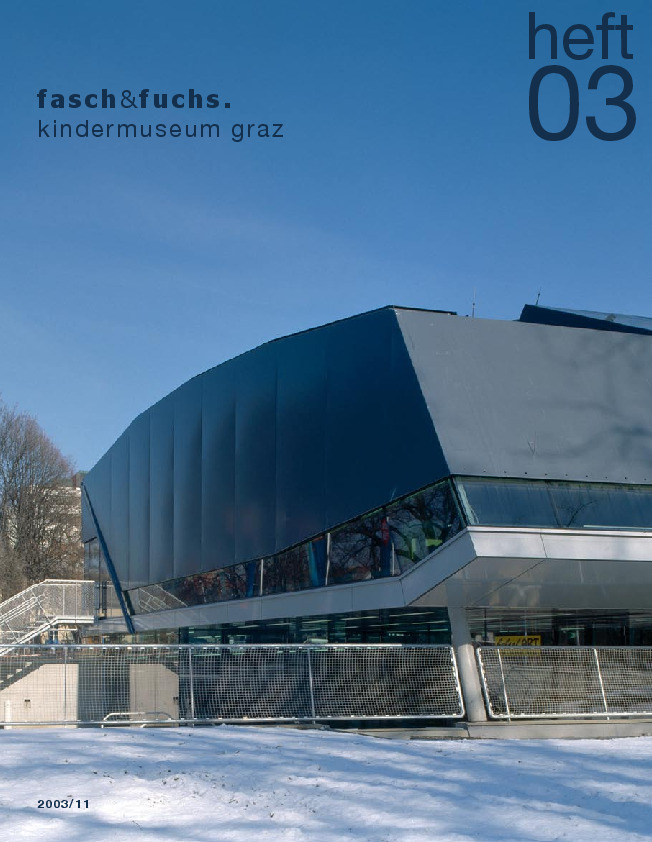
graz 2003 – european capital of culture. the children's museum is a place where children learn through play. it is not a museum in the sense of an ‘exhibition’, but rather a space for imparting knowledge and experiencing space. the long-cherished wish for a place where children could experiment was realised as part of the construction project for the european capital of culture 2003. the site of the former road maintenance depot at the northern end of the augarten was made available for the construction of the children's museum, close to the city centre and at the same time nestled in a large park landscape with a huge tree population.
graz 2003 – european capital of culture. the children's museum is a place where children learn through play. it is not a museum in the sense of an ‘exhibition’, but rather a space for imparting knowledge and experiencing space. the long-cherished wish for a place where children could experiment was realised as part of the construction project for the european capital of culture 2003. the site of the former road maintenance depot at the northern end of the augarten was made available for the construction of the children's museum, close to the city centre and at the same time nestled in a large park landscape with a huge tree population.
architectural concept
the location in the park and the intention to interweave the building and the surrounding park landscape are key influences on the spatial design. the shape and layout of the building respond to existing property boundaries, distance regulations and permissible height development. the requirement to accommodate exhibition spaces, an auditorium, workshops, quiet areas, administrative offices and storage on just 1,600 m² is solved by the concept of an open spatial continuum. the exhibition levels are connected by sloping surfaces that lead to seating areas and, through sliding elements.
the location in the park and the intention to interweave the building and the surrounding park landscape are key influences on the spatial design. the shape and layout of the building respond to existing property boundaries, distance regulations and permissible height development. the requirement to accommodate exhibition spaces, an auditorium, workshops, quiet areas, administrative offices and storage on just 1,600 m² is solved by the concept of an open spatial continuum. the exhibition levels are connected by sloping surfaces that lead to seating areas and, through sliding elements.
- location:
- friedrichgasse 34, 8020 graz, austria
- client:
- magistrat der stadt graz , hochbauamt
- team client:
- di heinz reiter
- general planning:
- fasch&fuchs.architekt:innen
- architecture:
- fasch&fuchs.architekt:innen
- team architecture:
- thomas ausweger, günter bösch, eva germann
- project management:
- thomas mennel
- structural engineering:
- werkraum ingenieure zt gmbh
- building physics:
- tomberger, graz
- building services engineering:
- bacher, wien , köstenbauer, graz
- photography:
- paul ott , helmut tezak, fasch&fuchs.architekt:innen
- competition:
- 2002
- project start:
- 2002
- execution:
- 2003
- gross floor area:
- 1.543m²
- building costs:
- 3,5 mio. euro
awards
2006 austrian architecture award, 1. prize
2005 nomination mies van der rohe prize, short list
2004 architecture prize of the state of styria
2004 geramb award for good construction
see competition