urban development concept
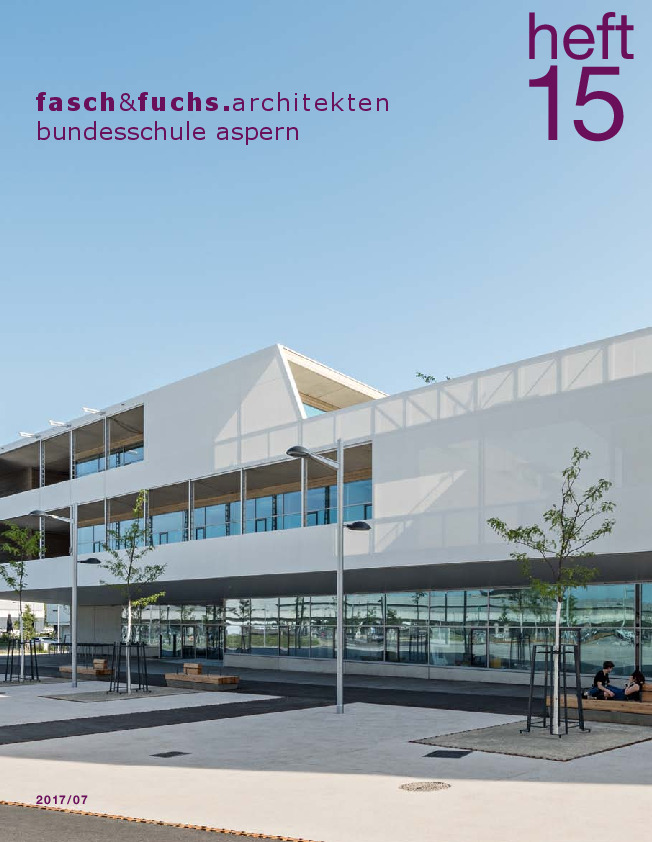
aspern, vienna's lakeside city, evokes images of living and working by the lake, of a district in which green spaces play a decisive role. to the north-west of the site earmarked for the federal school building lies hannah-arendt-park, and to the north-east is maria-trapp-platz. A key requirement for the competition site is the need for a public passageway in the south of the site. These are the urban planning constraints that form the basis of the present design. Based on the idea of a green city, the federal school building is conceived as a flat, terraced green landscape, an accessible educational hill. all clusters of secondary level 1 and all home bases of secondary level 2 have direct access to the green outdoor areas, where there is a generous range of different forms of recreation, play and outdoor learning.
in terms of urban planning, the building forms spatial edges towards Maria-Trapp-Platz, slightly set back from Edith-Piaf-Straße and the new passageway. the building is oriented towards Hannah-Arendt-Park with its clusters, home bases, afternoon care facilities and all outdoor areas. the required public passageway connects the southern corner of Hannah Arendt Park with Ella-Lingens-Straße. due to the compactness of the building and the generous use of the terrace areas as additional open spaces, the property south of the public passageway will not be used. the ground floor level of the education hill opens onto Maria-Trapp-Platz. this is where the large, rain-protected schoolyard is located – the main entrance area to the school. the entrance to the open hall – the indoor campus – leads across this forecourt.
at this interface between public space and school are the general areas for afternoon care, administration and the Department of Economics and Computer Science. this open hall connects the main entrance from Maria-Trapp-Platz with a second entrance from the public passageway and is also oriented towards the open spaces in the direction of Hannah-Arendt-Park.
to ensure optimal lighting for the compact structure, an open space has been carved out in its centre – the school forest, which serves as the focal point for the library, dining area and multi-purpose room. materials are delivered via the public passageway, and food deliveries are made via a short route to the kitchen.
aspern, vienna's lakeside city, evokes images of living and working by the lake, of a district in which green spaces play a decisive role. to the north-west of the site earmarked for the federal school building lies hannah-arendt-park, and to the north-east is maria-trapp-platz. A key requirement for the competition site is the need for a public passageway in the south of the site. These are the urban planning constraints that form the basis of the present design. Based on the idea of a green city, the federal school building is conceived as a flat, terraced green landscape, an accessible educational hill. all clusters of secondary level 1 and all home bases of secondary level 2 have direct access to the green outdoor areas, where there is a generous range of different forms of recreation, play and outdoor learning.
in terms of urban planning, the building forms spatial edges towards Maria-Trapp-Platz, slightly set back from Edith-Piaf-Straße and the new passageway. the building is oriented towards Hannah-Arendt-Park with its clusters, home bases, afternoon care facilities and all outdoor areas. the required public passageway connects the southern corner of Hannah Arendt Park with Ella-Lingens-Straße. due to the compactness of the building and the generous use of the terrace areas as additional open spaces, the property south of the public passageway will not be used. the ground floor level of the education hill opens onto Maria-Trapp-Platz. this is where the large, rain-protected schoolyard is located – the main entrance area to the school. the entrance to the open hall – the indoor campus – leads across this forecourt.
at this interface between public space and school are the general areas for afternoon care, administration and the Department of Economics and Computer Science. this open hall connects the main entrance from Maria-Trapp-Platz with a second entrance from the public passageway and is also oriented towards the open spaces in the direction of Hannah-Arendt-Park.
to ensure optimal lighting for the compact structure, an open space has been carved out in its centre – the school forest, which serves as the focal point for the library, dining area and multi-purpose room. materials are delivered via the public passageway, and food deliveries are made via a short route to the kitchen.
educational landscape
the indoor campus at the intersection of the two entrances is a space for events of all kinds, a meeting place for all students, inviting them to sit and observe. it is a place for relaxation, play and learning, and provides good orientation within the building. the spatial design of the indoor campus is intended to support the spirit of the school: openness, clarity, orientation, networking, generosity and light-flooded friendliness. in the warmer months, the dining room, multi-purpose room, library and workshops can be opened up to the covered outdoor areas. this allows students to eat or relax outdoors and work in outdoor studios.
clusters
the secondary level 1 teaching units are clearly laid out and structured on the first floor. four classrooms each are connected to the open learning zone, the collection room, the cloakroom and a small toilet unit to form a cluster. the classrooms of all four clusters face the Hannah Arendt Park via open areas in front of them. the learning zones open onto smaller, covered terraces, while large roof sheds extend the height of the space and provide additional optimal lighting. sliding walls allow the classrooms of a cluster to be opened up to the learning zones, while glass elements enable teachers to oversee the learning zones from the adjacent rooms. all classrooms have direct access to the open space directly in front of them.
home bases
the home bases for secondary level 2 are located on the second floor. all home bases face Hannah Arendt Park and have direct access to the large outdoor area, which is structured by sun-protected learning theatres, a playground, hills with trees and paved areas.
daylight, balconies
great attention is paid to glare-free daylighting. 1.5-metre-wide balconies ensure glare-free lighting in the school units and prevent overheating in summer. they also provide additional escape routes and make it very easy to clean the façades.
the indoor campus at the intersection of the two entrances is a space for events of all kinds, a meeting place for all students, inviting them to sit and observe. it is a place for relaxation, play and learning, and provides good orientation within the building. the spatial design of the indoor campus is intended to support the spirit of the school: openness, clarity, orientation, networking, generosity and light-flooded friendliness. in the warmer months, the dining room, multi-purpose room, library and workshops can be opened up to the covered outdoor areas. this allows students to eat or relax outdoors and work in outdoor studios.
clusters
the secondary level 1 teaching units are clearly laid out and structured on the first floor. four classrooms each are connected to the open learning zone, the collection room, the cloakroom and a small toilet unit to form a cluster. the classrooms of all four clusters face the Hannah Arendt Park via open areas in front of them. the learning zones open onto smaller, covered terraces, while large roof sheds extend the height of the space and provide additional optimal lighting. sliding walls allow the classrooms of a cluster to be opened up to the learning zones, while glass elements enable teachers to oversee the learning zones from the adjacent rooms. all classrooms have direct access to the open space directly in front of them.
home bases
the home bases for secondary level 2 are located on the second floor. all home bases face Hannah Arendt Park and have direct access to the large outdoor area, which is structured by sun-protected learning theatres, a playground, hills with trees and paved areas.
daylight, balconies
great attention is paid to glare-free daylighting. 1.5-metre-wide balconies ensure glare-free lighting in the school units and prevent overheating in summer. they also provide additional escape routes and make it very easy to clean the façades.
- location:
- maria-trapp-platz 5, 1220 wien, austria
- client:
- big bundesimmobilien gmbh
- general planning:
- fasch&fuchs.architekt:innen
- architecture:
- fasch&fuchs.architekt:innen
- team architecture:
- didem durakbasa, martin engstler, constanze menke, martin ornetzeder, stefanie schwertassek, elisabeth stoschitzky, heike weichselbaumer, martina ziesel
- project management:
- fred hofbauer
- specialist planner - cost management:
- arch. di günter bösch
- structural engineering:
- werkraum ingenieure zt gmbh
- building physics:
- exikon_skins
- building services engineering:
- thermo projekt gmbh
- electrical systems:
- tga plan gebäudetechnik gmbh
- fire safety:
- bm di alexander kunz
- color design:
- gustav deutsch und hanna schimek
- photography:
- hertha hurnaus , paul ott
- competition:
- 2012 - 2013
- planning:
- 2013 - 2017
- execution:
- 2014 - 2017
- gross floor area:
- 14.985m²
- gross volume:
- 77.795m³
- building costs:
- 32,0 mio. euro
awards
2022 award better learning environments
2020 nomination for the european architecture award
2020 sustainable building by ÖGNB and klimaaktiv
2019 barbara cappochin international architecture prize - winner of european best buildings
2019 state prize for architecture and sustainability
2019 nomination big see award
2018 shortlist european union prize for contemporary architecture - mies van der rohe award
2018 recognition aluminum architecture award
2018 building owner award
2018 sustainable building gold by ögnb and klimaaktiv
see competition